
One team or enterprise rollout?
A department can go deep on a few workflows; a wider rollout needs role segmentation, manager enablement and reinforcement.
Corporate AI training · Onsite & live online
Based in Bengaluru · delivering across India
Private AI training · Bengaluru organisations
Build role-specific, governed AI capability for business, leadership, analytics and technical teams—live online or at your Bangalore workplace.
Corporate AI Training in Bangalore is a private Technovids service for organisations that want employees to use or build with AI in a consistent, responsible way. Programmes can serve business users, managers, analysts, developers or mixed functions and may cover GenAI literacy, ChatGPT or Claude workflows, prompt engineering, AI-enhanced analytics, adoption planning or AI engineering. Technovids is headquartered in HSR Layout; delivery can be live online or onsite at the client’s Bangalore workplace when agreed.
Updated
Scope boundary: Training supports capability and responsible practice. It does not replace the client’s legal, privacy, security, HR, procurement or production-approval processes.
The right programme connects roles, approved tools, workplace tasks and review ownership.
A department can go deep on a few workflows; a wider rollout needs role segmentation, manager enablement and reinforcement.
Business-user training focuses on safe assistance. Developer training requires Python, APIs, evaluation and engineering controls.
Awareness can fit a short session; repeatable workplace practice needs exercises, feedback, ownership and follow-up.
Choose based on cohort distribution, facilities, practice needs and schedule; confirm venue and travel in the proposal.
Examples are adapted to participant roles and the organisation’s approved tools, data and policies.
Frame a question, gather permitted material and produce a decision-ready summary.
Create a first draft from an approved brief, examples and explicit constraints.
Transform approved notes or transcripts into decisions, actions and follow-up drafts.
Use AI to explain fields, propose checks, draft formulas or organise observations.
Draft a response from an approved brief, knowledge source and escalation rule.
Compare candidate workflows by value, feasibility, risk, ownership and evidence.
Private programmes can combine compatible modules after audience and prerequisites are clear.
Create a shared baseline on GenAI, limits, suitable use and organisational boundaries.
Best for: Cross-functional employees and managers beginning adoption
Practise research, drafting, analysis and communication with approved assistants.
Best for: HR, sales, marketing, finance and operations teams
Prioritise use cases, governance, operating ownership and change decisions.
Best for: Leaders, transformation teams, L&D and AI champions
Build and evaluate RAG, agents, MCP and deployable AI services.
Best for: Software, data, platform and AI engineering teams
A company cohort has a different design and accountability model from individual enrolment.
| Decision point | Public live-online course | Private corporate training |
|---|---|---|
| Audience | Individuals from different organisations | One organisation’s selected participants |
| Curriculum | Published cohort curriculum | Adapted to roles, tools and client boundaries |
| Delivery | Live online | Private live online or client workplace |
| Commercials | Confirmed per cohort | Confirmed in the company proposal |
Technovids customizes the agenda, duration, delivery format and exercises based on team roles, existing skill levels and business goals. Select the tracks that fit your organization.
🧠 Track 01Each department has distinct AI opportunities. All AI-generated output requires human review before use.
| Department | Example AI Workflow | Training Focus | Human Review |
|---|---|---|---|
| HR | Job description drafting, interview question frameworks, onboarding content, employee communication templates | AI writing and prompt design for HR workflows | ✓ Required |
| Marketing | Campaign brief research, content repurposing, competitive analysis, creative brief generation | Research-to-brief AI productivity, content quality review | ✓ Required |
| Sales | Account research, proposal draft support, meeting preparation notes, follow-up draft generation | AI-assisted research and writing for sales cycles | ✓ Required |
| Finance | Report summary drafting, commentary on dashboards, spreadsheet interpretation, analysis support | AI for reporting and analytical commentary workflows | ✓ Required |
| Operations | SOP drafting, process documentation, issue summarization, workflow improvement suggestions | Document generation and process knowledge workflows | ✓ Required |
| Leadership | Executive briefing support, scenario exploration, AI adoption planning, decision preparation | AI strategy, governance and adoption management | ✓ Required |
| Customer Support | Response draft support, knowledge search, case summarization, escalation preparation | AI-assisted support workflow efficiency | ✓ Required |
| Product | Requirement draft support, feedback synthesis, user-research summaries, documentation | AI for discovery, synthesis and writing workflows | ✓ Required |
| Analytics | SQL query assistance, report interpretation, dashboard commentary, data-question framing | AI tools for analytical tasks and data storytelling | ✓ Required |
| IT and Engineering | Code documentation, debugging support, code review assistance, RAG and agent workflow design | AI engineering, LLM applications and technical productivity | ✓ Required |
Modules are selected and sequenced based on your team composition and training objectives. Not every engagement includes all modules.
LLM concepts, business opportunities, limitations, hallucinations and workplace responsibility — without technical jargon.
Clear instructions, context setting, examples, structured outputs, iterative refinement and reusable prompt patterns.
Summarization, information extraction, comparison, report support, source review and verification practices.
Emails, presentations, SOPs, reports, meeting notes and knowledge work — with practical exercise for each.
Tool selection guidance, workplace use cases, file and document handling, connected tool concepts and feature qualifications.
HR, marketing, finance, operations, sales, leadership, support and product — customized exercises for each function.
Acceptable use, sensitive information handling, human review requirements, bias awareness, hallucination detection and escalation.
Repeatable workflows, connected apps, no-code automation awareness, agent concepts, tool use and permission boundaries.
Reporting support, SQL assistance, dashboard interpretation, data-quality review and analytical output validation.
RAG, AI agents, MCP, evaluation, monitoring and LLMOps awareness for engineering and technical teams.
Identify priority workflows, map departments, define safeguards, select pilots and create an initial adoption plan.
AI champions, phased rollout, employee support, measurement, review cadence and planning for next-level training.
Different teams within the same organization may be at different maturity levels. Training is designed to meet teams where they are and advance them to the next level.
Employees understand what AI can and cannot do and recognize its role in their industry.
Individuals use AI tools daily for personal tasks — writing, research, summarization and analysis.
Employees have established, repeatable AI workflows for their specific job functions.
Entire departments use AI consistently with shared prompts, standards and review processes.
AI connects to organizational tools and data under defined governance, permissions and review.
Technical teams deploy AI systems, agents and automations that serve other employees at scale.
Choose the depth around the decisions and practice your team needs. An executive awareness session can be scoped around two to three hours; a half-day or full-day workshop provides a different level of practice. These are format examples, with the final duration and agenda agreed in the proposal.
Compare ChatGPT Enterprise, Claude Enterprise and leadership training when choosing the starting audience. Dates, materials, environment provisioning and follow-up scope are confirmed for the engagement.
The engagement should leave evidence of capability and next action rather than a vague adoption claim.
Participants understand the concepts and risks needed for their responsibilities.
Teams practise bounded tasks with clear inputs, outputs, checks and owners.
Candidate applications are compared by value, feasibility, risk and evidence.
The organisation has an owner, boundary and measurement plan for a suitable follow-on.
A written proposal connects the business need, audience, practice and delivery conditions before training starts.
Chandan clarifies the business need, participant roles, location, schedule and expected change with the client team.
A suitable expert reviews starting level, approved tools, examples, practice data, risks and technical requirements.
The proposal confirms agenda, format, duration, participant assumptions, inclusions, exclusions, venue and commercials.
Explanations alternate with demonstrations, role-relevant practice, feedback and accountable review.
The agreed materials, completion information and next-step recommendations are handed over under the proposal terms.
Local presence does not replace a complete delivery agreement.
Roles, levels, tools, accounts, policies and technical preparation.
Topics, exercises, outputs and client-context boundaries.
Online or onsite mode, Bangalore venue, facilities, schedule, participant count and travel.
Materials, completion criteria, follow-up, fee, taxes, exclusions and responsibilities.
Participants practise AI assistance with organisational boundaries and human accountability visible at every material step.
Accounts, confidential information, personal data and intellectual property follow the organisation’s existing policies and approved environment.
Facts, calculations, sources, tone, completeness and decision impact are checked against the original material and task.
AI can assist drafting or analysis; an accountable person still reviews the work and owns the action or decision.
Teams compare quality, effort, adoption and risk for a defined workflow rather than claiming generic productivity gains.
Leadership and adoption discussions work from published frameworks rather than a Technovids opinion, so a client can check the reasoning and map it to its own policy. These are reference documents for structuring the conversation; they are not certifications, and none of them replaces the organisation’s own legal, privacy, security and risk approvals.
Real instructor-led sessions from the Technovids delivery archive. The photographs show delivery context; they do not imply a result for a future cohort.


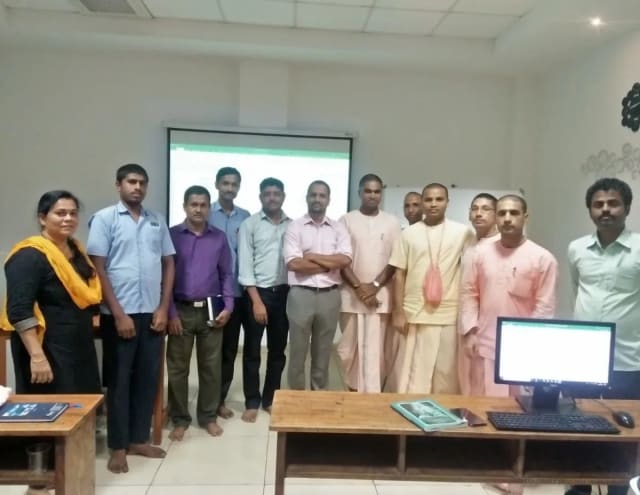
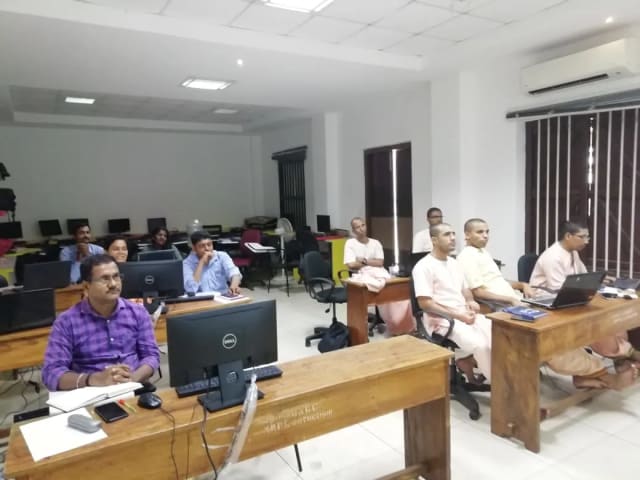


Technovids assigns a suitable trainer after the audience, subject depth and delivery needs are confirmed.
Co-founder & Lead Instructor, Technovids Consulting
Pankaj is a co-founder and the lead instructor at Technovids Consulting. His programme work spans practical AI adoption, AI engineering, evaluation, responsible production AI, data analytics and corporate learning design, with an emphasis on hands-on exercises connected to workplace tasks.
Expertise:
AI & Machine Learning Trainer, Strategist and Consultant
Junaid is an AI and machine-learning trainer, strategist and consultant with more than 22 years of training experience. His work combines enterprise AI education, business-centred adoption, responsible AI practices and applied solution design, helping professional audiences connect AI concepts to real organisational needs.
M.E. in Computer Engineering, specialising in Artificial Intelligence · author of programming books on Python, Java and C++
Expertise:
Technical Trainer & Curriculum Architect
Pradeep is a technical trainer and curriculum architect with more than 20 years of experience across enterprise technology, cloud infrastructure and advanced AI systems. He designs practitioner-focused programmes, labs and assessments covering AI, LLM systems, Python and machine learning, translating complex technical subjects into structured learning experiences.
Bachelor of Engineering in Electrical Engineering · instructor-led, virtual and blended delivery
Expertise:
The proposal names or confirms the trainer assignment for the engagement; every trainer shown here does not teach every programme.
Updated
Approved feedback and real Technovids training photographs show delivery context. They do not promise the same outcome for every participant or organisation.



















Practical training programmes delivered for learners, professionals and teams across AI, data, cloud, productivity and professional skills.
What professionals found useful, practical and relevant to their day-to-day work.
I knew Generative AI was changing digital marketing, but I didn't know where to start without a tech background. The AI for Business Professionals course at Technovids was exactly what I needed. It completely demystified tools like ChatGPT, Claude, and Midjourney for commercial use. We are now using the prompt frameworks taught in the class to automate content generation and market research, saving us nearly 15 hours a week. Highly recommended for marketing leaders.
Most AI courses are too focused on Python and coding. Technovids has created the perfect GenAI course for non-technical professionals. The modules focus heavily on business use cases, process automation, and identifying AI ROI. Learning how to integrate AI into our daily workflows and understanding the data privacy implications has given me the confidence to champion AI adoption across our operations team.
I enrolled in this program to figure out how to leverage AI for data storytelling and reporting. The practical walkthroughs on using AI tools for data analysis, specifically around Microsoft Copilot and advanced prompting for business intelligence, were eye-opening. The Technovids trainers keep it 100% practical. I walked away with actionable templates that I started using at work the very next day.
I have zero background in IT, so I was hesitant to take an AI course. I shouldn't have been. The trainers at Technovids explain complex AI concepts using everyday business analogies. There is absolutely no coding required. By the end of the program, I was confidently writing complex prompts to generate business proposals and competitive analysis reports. It is the perfect AI course for beginners in management.
The landscape of B2B sales is shifting rapidly with AI, and this course helps you stay ahead of the curve. The training helped me understand how to leverage AI tools for personalized customer outreach, CRM data cleanup, and predictive sales insights. The real-world case studies discussed during the live sessions were incredibly valuable. If you want to use AI to drive business growth and revenue, this is the training to take.
When you run a lean startup, productivity is everything. This Technovids course taught me how to use AI as a 'co-pilot' for my business. From automating sales outreach to summarizing long legal documents, the practical use cases covered in the workshops are gold. It bridges the gap between AI hype and actual business execution perfectly. Easily the best investment I’ve made in my own learning this year.
Published answers define the page scope. A written proposal records engagement-specific terms.
It is private, role-based training that helps one organisation’s employees use or build with AI under agreed tools, data, policies and review practices. Scope can range from literacy and workplace use to analytics, adoption and engineering.
Yes, when onsite delivery is agreed. The proposal confirms venue, room and network requirements, participant count, schedule, travel, equipment responsibilities and commercials. Private live-online delivery is also available.
HSR Layout is the Technovids head office, not a public or default corporate classroom. Corporate onsite delivery means the client’s agreed workplace unless another venue is explicitly contracted.
A capability plan can include both, but the learning tracks should separate. Business users need safe workflow practice; developers need programming, APIs, evaluation and production controls.
The proposal can adapt examples, modules and practice to roles, approved tools and business needs. It does not use confidential client data unless authorised, prepared and handled in an agreed environment.
The parties select evidence appropriate to the scope—for example an exercise rubric, workflow review, project demonstration, knowledge check or bounded adoption measure. No universal productivity percentage is promised.
2nd Floor, Chandrodaya Complex, 19/19, 24th Main Rd, near Hanuman Temple, Agara Village, 1st Sector, HSR Layout, Bengaluru, Karnataka 560102.
Please contact us before visiting the head office. The HSR Layout address is a head office, not a walk-in public classroom.