
2-day programme · Practice and feedback
Leadership Training Programme — For Managers Who Lead in a Changing World
Help managers move beyond individual execution by practising delegation, feedback, executive communication and change leadership on situations they actually face.
- Duration
- 2 days · 16 hours
- Audience
- Managers and emerging leaders
- Practice
- Role plays and peer feedback
- Output
- 90-day leadership action plan
What is the Leadership Training Programme course?
The Leadership Training Programme is a 16-hour corporate workshop for first-time, mid-level and emerging senior leaders. It develops four connected capabilities: leadership identity and strategic judgement, delegation and accountability, executive communication and influence, and leading teams through change. Participants practise difficult conversations and briefings, receive structured feedback, and leave with a 90-day action plan grounded in a real leadership challenge.
Is this the right course for you or your team?
Who it is for
- First-time managers moving from individual contribution to team leadership
- Mid-level managers who need stronger delegation, feedback and cross-functional influence
- High-potential professionals preparing for wider responsibility
- Leadership cohorts navigating growth, restructuring or technology-led change
Situations it fits
- Managers retain work instead of delegating ownership clearly
- Feedback happens late or avoids the behaviour that needs to change
- Important recommendations are not communicated with executive clarity
- A transformation is creating uncertainty, resistance or unclear accountability
Prerequisites
- Participants should currently lead people, projects or important cross-functional work
- Each participant brings one real leadership situation that can be anonymised for practice
- This is not a legal or HR-compliance course for disciplinary action
When a different course fits better
Choose the narrower course when the development need is specific.
- AI Change Managementfor adoption and workforce-change leaders focused specifically on AI
- Professional Development Trainingfor communication and structured-thinking capability across career levels
The business problems this course addresses
Leadership capability becomes visible in conversations and decisions, so the course is built around practice.
| Task | The usual problem | What participants practise |
|---|---|---|
| Delegate important work | The manager either keeps control or hands off a task without context, authority or checkpoints. | Define outcome, boundary, decision rights, support and review cadence in one delegation conversation. |
| Address performance | Feedback stays vague, delayed or personal. | Describe observable behaviour and impact, listen, agree the next behaviour and document follow-through. |
| Influence stakeholders | A long update hides the decision, trade-off and ask. | Structure an executive briefing around the decision, evidence, risk and required action. |
| Lead through change | Leaders broadcast announcements but do not address role impact, uncertainty or resistance. | Map stakeholders, listen for the type of resistance and plan communication plus reinforcement. |
What participants will be able to do
Practise the skills below through course exercises, then check the results and explain how you would apply them to your work.
Define a leadership approach
Articulate the shift from personal execution to direction, context, accountability and team development.
Delegate with clarity
Set outcomes, authority, boundaries and checkpoints without micromanaging or abandoning ownership.
Give actionable feedback
Hold a direct, evidence-based conversation and agree a follow-up behaviour.
Communicate upward
Deliver a concise executive briefing that makes the decision and ask easy to understand.
Influence across functions
Identify stakeholder interests, evidence and trade-offs before seeking commitment.
Lead a change conversation
Respond to uncertainty and resistance with honest communication, involvement and reinforcement.
Applied to each team’s real work
First-time managers
Role transition, expectations, delegation, feedback and team routines.
Mid-level managers
Strategic context, cross-functional influence, accountability and executive communication.
High-potential leaders
Ambiguity, stakeholder judgement, leadership identity and broader organisational perspective.
Transformation leaders
Stakeholder mapping, resistance, communication and sustained change behaviour.
2 days · 16 live hours
Detailed curriculum
4 modules, each pairing short instruction with guided practice. Sequence and examples can be adjusted after the training-needs discussion; the core outcomes stay the same.
Day 1
Module 14 hours Leadership identity and strategic thinking
- The shift from individual contributor to leader
- Leadership strengths, blind spots and situational adaptation
- Business context and stakeholder perspective
- Prioritisation under competing demands
Practical activityWrite a leadership operating statement and apply it to a current priority conflict.
Module 24 hours Delegation, feedback and accountability
- Outcome and decision-right clarity
- Checkpoints without micromanagement
- Behaviour-based feedback
- Underperformance and follow-through
Practical activityRun a delegation or feedback role play and revise the conversation from peer observations.
Day 2
Module 34 hours Executive communication and influence
- Bottom-line-first briefing
- Evidence, trade-offs and the decision ask
- Influencing without formal authority
- Listening and difficult stakeholder conversations
Practical activityDeliver a three-minute executive briefing and receive structured feedback.
Module 44 hours Leading teams through change
- Role impact and uncertainty
- Stakeholder and resistance mapping
- Communication, involvement and reinforcement
- Leadership habits for a changing workplace
Practical activityBuild a 90-day leadership action plan for a real, anonymised change.
Need the agenda built around your team’s work?
Share the roles attending and the tasks to improve. The proposal sets out the adapted agenda.
Exercises and practical outputs
Short explanations lead into guided practice, review and a workplace application.
How every module runs
Understand
Learn the decision model, vocabulary and expected standard.
Observe
Watch the trainer apply the method to a realistic example.
Practise
Complete a bounded task, lab, role play or working exercise.
Review
Use evidence and feedback to improve the output and define the next application.
Exercises use representative, non-sensitive examples. Outputs are produced during the workshop for practice and review; anything participants keep is their own working material.
How the course is tailored and delivered
Private delivery is shaped around the organisation’s roles, starting level, systems, policies and situations participants must handle after training.
From first conversation to evaluation
Clarify the job outcome
Agree what participants should be able to explain, perform or produce after the programme.
Check the starting point
Review experience, tools, terminology and access so the course does not begin at the wrong level.
Select realistic practice
Choose useful scenarios and datasets without exposing confidential or restricted information.
Define completion evidence
Confirm the practical output, feedback method and follow-up expected from participants.
Delivery formats
Private corporate cohort
Best for: One organisation aligning participants around a shared platform or capability
Delivered live online or onsite. Scope, exercises, prerequisites, participant count and support are confirmed in the proposal.
Modular programme
Best for: Teams that need learning spaced around work and application
The core curriculum can be divided into shorter sessions with practice between modules. The agreed schedule and handover are documented before delivery.
Delivery modes
Live online
Facilitated sessions with demonstrations, breakout practice, review and shared working artefacts.
Onsite
Private delivery at the client location, with prerequisites and room or lab requirements agreed before the programme.
Practice, feedback and working sessions—not a slide marathon
Technovids training sessions in different group settings. The photographs do not attribute a particular client, course or outcome.

Photo 1 of 10: Hands-on session 
Photo 2 of 10: Group photo 
Photo 3 of 10: Hands-on session 
Photo 4 of 10: Group photo 
Photo 5 of 10: Classroom session 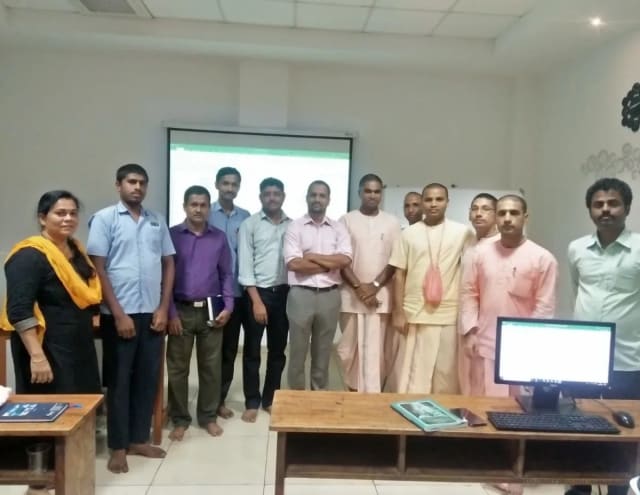
Photo 6 of 10: Group photo 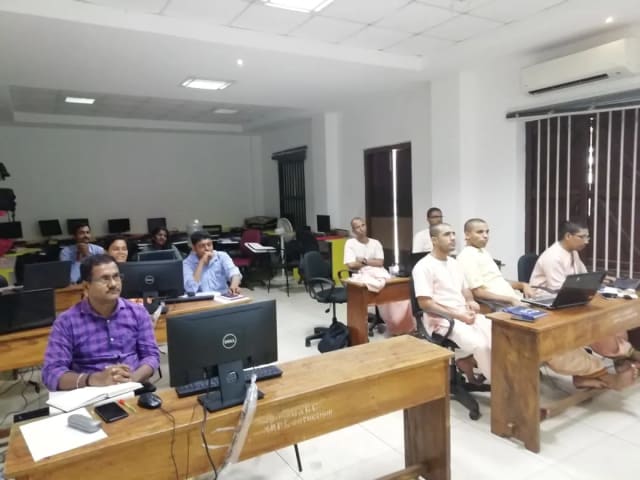
Photo 7 of 10: Computer-lab session 
Photo 8 of 10: Group photo 
Photo 9 of 10: Classroom session 
Photo 10 of 10: Group photo
For L&D and procurement teams
The published course parameters on one page. Final scope, dates and fees are confirmed in the written proposal.
Discuss your team’s requirements| Course | Leadership Training Programme |
|---|---|
| Duration | 16 live hours across 2 days or an agreed modular schedule |
| Audience | First-time managers, mid-level managers and emerging senior leaders |
| Recommended group | 12–20 participants for role-play quality and feedback |
| Practice | Delegation, feedback, executive briefing and change-leadership scenarios |
| Output | Personal leadership operating statement and 90-day action plan |
Who may deliver this programme
Technovids assigns a trainer whose subject depth and facilitation experience fit the audience and agreed scope.
Pankaj Rana
Co-founder & Lead Instructor, Technovids Consulting
Pankaj is a co-founder and the lead instructor at Technovids Consulting. His programme work spans practical AI adoption, AI engineering, evaluation, responsible production AI, data analytics and corporate learning design, with an emphasis on hands-on exercises connected to workplace tasks.
Expertise:
- Practical AI adoption
- Prompting and evaluation
- Responsible AI
- Corporate learning design
Junaid Khateeb
AI & Machine Learning Trainer, Strategist and Consultant
Junaid is an AI and machine-learning trainer, strategist and consultant with more than 22 years of training experience. His work combines enterprise AI education, business-centred adoption, responsible AI practices and applied solution design, helping professional audiences connect AI concepts to real organisational needs.
M.E. in Computer Engineering, specialising in Artificial Intelligence · author of programming books on Python, Java and C++
Expertise:
- Enterprise AI and ML training
- AI strategy and adoption
- Responsible AI
- Applied AI solution design
Pradeep Varadarajan
Technical Trainer & Curriculum Architect
Pradeep is a technical trainer and curriculum architect with more than 20 years of experience across enterprise technology, cloud infrastructure and advanced AI systems. He designs practitioner-focused programmes, labs and assessments covering AI, LLM systems, Python and machine learning, translating complex technical subjects into structured learning experiences.
Bachelor of Engineering in Electrical Engineering · instructor-led, virtual and blended delivery
Expertise:
- AI and LLM systems
- Curriculum architecture
- Python and machine learning
- Hands-on lab design
The trainer for a specific delivery is confirmed with the schedule or written proposal.
Updated
Organisations we have trained, and participant perspectives
Permissioned feedback and published client relationships provide context on delivery. They do not guarantee a certification, promotion, pipeline or business result.
Organisations we have delivered training for



















Practical training programmes delivered for learners, professionals and teams across AI, data, cloud, productivity and professional skills.
Participant experiences across workplace roles
What professionals found useful, practical and relevant to their day-to-day work.
- Gauraw DeshmukhData Engineer · Capgemini
Technovids AI training was very practical and well structured. The sessions helped me understand how AI concepts can be applied in real data engineering and business workflows, instead of only learning theory. The trainer explained the topics clearly with relevant examples, which made the learning experience valuable and easy to follow.
- PriyanshaSoftware Developer
The AI training from Technovids helped me gain a better understanding of Generative AI, prompt engineering, and practical AI use cases for software development. The course was clear, interactive, and focused on real-world applications. It gave me confidence to explore AI tools more effectively in my work.
- Sidda RajuData Engineer
Technovids delivered the AI training in a very practical and industry-relevant way. As a data engineer, I found the examples and hands-on discussions useful for understanding how AI can improve data workflows, automation, and decision-making. The sessions were well planned and easy to understand.
- Akshat KabraData Engineer
The AI training program by Technovids was insightful and professionally delivered. It covered important AI concepts in a simple and practical manner, with examples that connected well with data and analytics use cases. The sessions helped me build a stronger foundation in applying AI in real business scenarios.
- MangeshSoftware Engineer · Siemens
Technovids conducted the AI training in a very effective and engaging manner. The sessions were practical, easy to follow, and focused on how AI can be used in real software engineering and business workflows. It was a valuable program for understanding the current direction of AI adoption in the industry.
- ReshuSoftware Developer
Technovids AI training was a very useful learning experience. The course explained AI concepts in a practical way and showed how developers can use AI tools to improve productivity, problem-solving, and application development. The trainer's approach was simple, clear, and focused on industry use cases.
Common questions before planning this course
Answers about the published course. The written proposal records any agreed customisation, delivery details and commercials.
Can the Leadership Training Programme be customised for our organisation?
Yes. Private programmes can reflect participant roles, starting level, approved systems, industry context and agreed workplace situations. The final agenda and outputs are documented in the proposal.
Can this be delivered onsite or live online?
Yes. Both modes are available for private cohorts. Dates, location, session pattern, participant count and technical or room prerequisites are confirmed in writing.
Is a Technovids completion certificate included?
Yes, for participants who meet the stated completion requirements. Each Technovids certificate has a unique ID that can be verified on the Technovids website. It is not a cloud-vendor or professional-body certification.
How is leadership training different from management-process training?
This programme concentrates on judgement, communication, influence and behaviour in leadership situations. Processes such as performance-review administration or organisation-specific HR policy can be included only when explicitly scoped with the client.
Does the course include leading through AI change?
It includes a broader change-leadership module that can use AI adoption as one context. Choose the dedicated AI Change Management programme when workforce AI adoption is the central objective.
How is behaviour change evaluated?
Participants practise observable behaviours during the programme and leave with application commitments. Any manager follow-up, 360 input or later evaluation is defined per engagement rather than implied as automatic.
Can senior leaders and first-time managers attend together?
They can, but practice is usually stronger when participants face comparable leadership situations. Discovery should determine whether separate cohorts or role-specific breakouts are more useful.
Turn a training requirement into a clear course proposal
Share the audience, team size, delivery preference and the work you want to improve. Technovids will scope the programme and confirm the details in a written proposal.