
Is your Python ready?
You should write functions and classes, install packages, work at the command line and call a REST API.
Corporate AI training · Onsite & live online
Based in Bengaluru · delivering across India
80-hour live-online cohort · For Python developers
Build RAG applications, controlled agents, MCP integrations and deployable AI services through 40 live hours and about 40 hours of guided project work.
AI Engineering Course Bangalore is Technovids’ live-online, eight-week programme for developers who already write Python. It combines 40 hours of instructor-led Zoom classes with about 40 hours of guided work across five GitHub portfolio projects. The curriculum covers model APIs, RAG and evaluation, LangGraph-based controlled agents, MCP integrations, FastAPI, Docker, deployment and operational review. Technovids is headquartered in HSR Layout, Bengaluru; the public cohort is online and does not include classroom attendance.
Updated
Scope boundary: This is not a beginner Python course, a job guarantee or a promise that classroom projects are production-ready. Participants arrange a suitable laptop and their own model API usage if required.
The programme moves quickly because it builds on programming fundamentals rather than teaching Python from zero.
You should write functions and classes, install packages, work at the command line and call a REST API.
Plan for roughly five live hours and five guided project hours a week across eight weeks.
Projects may require model APIs and hosting. Learners use eligible free tiers where suitable or their own paid account and usage.
Meet the stated attendance and submission requirements and complete the five project checkpoints.
Each build has an acceptance check and a hosted demonstration path; hosting depends on platform eligibility and the learner’s own account.
Create a small service with validated inputs, structured outputs, retries and error handling.
Ingest documents, retrieve evidence and answer with citations.
Use tools, state, stopping rules and a human approval checkpoint.
Connect a compatible client and server with scoped tools or resources.
Combine API, retrieval or agents with deployment, evaluation and operations evidence.
Explain decisions, failures and trade-offs from the code and evidence.
Use the broader programme when the goal is an end-to-end transition; use focused pages when one missing capability is clear.
This page
The full 80-hour live and guided public-cohort route.
Best for: Individual Python developers seeking structured portfolio work
Strengthen the Python, API and data-handling foundation first.
Best for: Learners not yet comfortable with the prerequisites
Go directly to RAG, LangChain, MCP or agentic AI when foundations are already strong.
Best for: Developers solving one architecture or framework gap
Use the private corporate programme when an employer is training its own engineering group.
Best for: Company developer teams and technical leaders
The technical domain overlaps, but audience, schedule and evidence model differ.
| Decision point | Public 80-hour course | Private corporate programme |
|---|---|---|
| Audience | Individual Python developers | One organisation’s engineering team |
| Format | 40 live hours + about 40 project hours | 40 hours as five full or ten half days |
| Context | Portfolio-oriented project briefs | Client-relevant examples and team constraints |
| Commercials | Confirmed with the scheduled cohort | Confirmed in a corporate proposal |
The result is a set of explainable projects and engineering evidence, not a placement or production-readiness claim.
Explain component boundaries, alternatives, data flow and important trade-offs.
Run the five builds and show how inputs, outputs, errors and controls behave.
Use representative tests and traces to discuss quality, failure, latency and cost.
Identify security, scale, observability, data and support work beyond the classroom build.
The next confirmed cohort information is shared before enrolment, and the learning path keeps practice and review visible.
Share your background, current tools and goal. Chandan discusses fit first; a subject-matter expert follows up when technical depth is needed.
Receive the current dates, live schedule, fee, prerequisites, inclusions and cancellation or transfer terms before deciding.
Complete the stated setup using your own suitable device and any accounts or paid API access required for the selected course.
Join live Zoom classes, complete exercises or projects, use LMS resources and apply instructor feedback.
Submit the agreed work and receive a Technovids completion certificate with a unique website-verifiable ID when the stated requirements are met.
The course combines live teaching, guided building and a consistent online learning environment.
Participants provide their own laptop. Any paid model API usage or learner-owned AWS/Azure account charges are paid directly by the learner; eligible free hosting tiers may be used where suitable.
Weekend or weekday late-evening Zoom sessions, with the exact timetable confirmed per cohort.
Five project briefs, checkpoints, lab instructions and trainer review.
Notes, assignments, lab instructions, cohort group and recordings uploaded within 24 hours with three months of access.
A Technovids certificate with a unique website-verifiable ID when course requirements are met.
Participants practise AI assistance with organisational boundaries and human accountability visible at every material step.
Accounts, confidential information, personal data and intellectual property follow the organisation’s existing policies and approved environment.
Facts, calculations, sources, tone, completeness and decision impact are checked against the original material and task.
AI can assist drafting or analysis; an accountable person still reviews the work and owns the action or decision.
Teams compare quality, effort, adoption and risk for a defined workflow rather than claiming generic productivity gains.
Framework and protocol versions are checked before each cohort; official documentation remains the source of truth for changing APIs.
Real instructor-led sessions from the Technovids delivery archive. The photographs show delivery context; they do not imply a result for a future cohort.


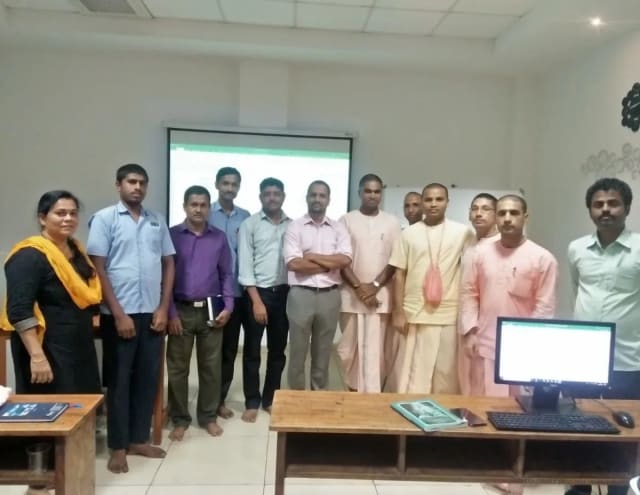
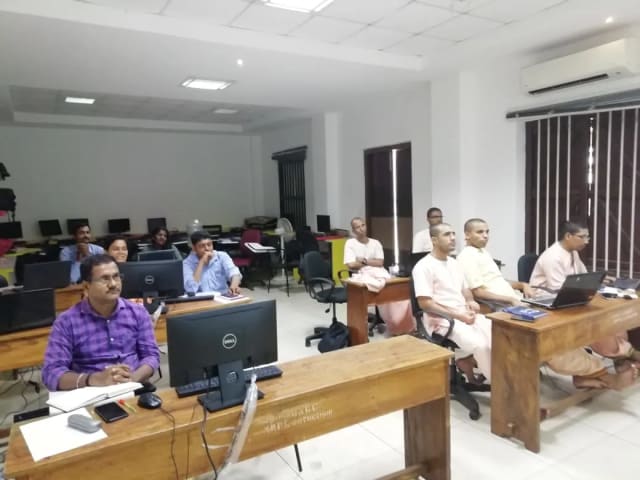


Technovids assigns a suitable trainer after the audience, subject depth and delivery needs are confirmed.
Co-founder & Lead Instructor, Technovids Consulting
Pankaj is a co-founder and the lead instructor at Technovids Consulting. His programme work spans practical AI adoption, AI engineering, evaluation, responsible production AI, data analytics and corporate learning design, with an emphasis on hands-on exercises connected to workplace tasks.
Expertise:
AI & Machine Learning Trainer, Strategist and Consultant
Junaid is an AI and machine-learning trainer, strategist and consultant with more than 22 years of training experience. His work combines enterprise AI education, business-centred adoption, responsible AI practices and applied solution design, helping professional audiences connect AI concepts to real organisational needs.
M.E. in Computer Engineering, specialising in Artificial Intelligence · author of programming books on Python, Java and C++
Expertise:
Technical Trainer & Curriculum Architect
Pradeep is a technical trainer and curriculum architect with more than 20 years of experience across enterprise technology, cloud infrastructure and advanced AI systems. He designs practitioner-focused programmes, labs and assessments covering AI, LLM systems, Python and machine learning, translating complex technical subjects into structured learning experiences.
Bachelor of Engineering in Electrical Engineering · instructor-led, virtual and blended delivery
Expertise:
The proposal names or confirms the trainer assignment for the engagement; every trainer shown here does not teach every programme.
Updated
Approved learner feedback and training photographs help you inspect the wider delivery experience. They are not employment, certification or project-result guarantees.


















Practical training programmes delivered for learners, professionals and teams across AI, data, cloud, productivity and professional skills.
What professionals found useful, practical and relevant to their day-to-day work.
I had been trying to transition from traditional backend development to Generative AI, but self-learning was getting overwhelming. The AI Engineering course at Technovids gave me the exact structured roadmap I needed. The modules on LLM architectures and practical prompt engineering are brilliant. It’s not just theory; you actually build functional AI applications. Highly recommend this for working professionals looking to upgrade their tech stack.
Finding a course that goes deep into Retrieval-Augmented Generation (RAG) is surprisingly hard. Most just scratch the surface. Technovids delivered an incredibly detailed deep dive into RAG pipelines, LangChain, and LlamaIndex. The hands-on projects helped me understand how to manage vector databases and chunking strategies effectively. It’s easily the most practical Generative AI training I’ve taken.
If you want to understand agentic AI, this is the course to take. The instructor did a fantastic job breaking down complex topics like LangGraph and cyclical agents, which are rarely covered well in other bootcamps. Learning how to orchestrate multiple AI agents to solve complex workflows has completely changed how I approach architecture at my current job. Worth every penny.
What I loved most about the Technovids GenAI program is how up-to-date the curriculum is. Instead of outdated practices, we learned to integrate the Model Context Protocol (MCP) and practically apply tools like Claude and Cursor for AI-assisted coding. It felt like I was learning the exact skills that top tech companies are hiring for right now. The pace is perfect, and the support is great.
I was initially intimidated by the math and complexity behind AI, but the trainers at Technovids explain things in such an accessible way. They break down everything from basic prompt engineering to complex integrations without losing you in the jargon. The session recordings and project materials are top-notch. If you are serious about becoming an AI Engineer, Technovids provides the perfect launchpad.
I didn't want a purely academic course; I wanted to code. Technovids pushes you to actually build things. The curriculum is heavily focused on real-world use cases, ensuring you know how to build robust, scalable applications using LangChain and advanced AI models. It’s intensive, fast-paced, and exactly what the current job market demands.
Published answers define the page scope. A written proposal records engagement-specific terms.
It is an 80-hour programme across eight weeks: 40 hours of live instructor-led Zoom classes plus about 40 hours of guided project work. The confirmed cohort timetable states the exact days and times.
You should be comfortable with functions, classes, lists and dictionaries, installing packages, basic command-line work and calling a REST API from Python. If not, start with AI Programming with Python.
Each project has a hosted demonstration path. Learners can use a compatible eligible free tier such as Vercel or Cloudflare where appropriate, or their own AWS or Azure free or paid account. Availability and charges depend on the platform and learner account.
Learners pay providers directly for their own usage when paid access is required. Suitable free tiers can be used where available and eligible; Technovids does not promise that every project remains free to host or run.
No. HSR Layout is the Technovids head office, not a public classroom. Confirmed public cohorts run live online through Zoom. The Technovids LMS includes notes, assignments, lab instructions, a cohort discussion group and a completion certificate when requirements are met. Class recordings are uploaded within 24 hours and remain available for three months.
No. The Technovids completion certificate records programme completion and can be verified using its unique ID on the website. Employment depends on demonstrated skill, experience, interviews and employer decisions.
2nd Floor, Chandrodaya Complex, 19/19, 24th Main Rd, near Hanuman Temple, Agara Village, 1st Sector, HSR Layout, Bengaluru, Karnataka 560102.
Please contact us before visiting the head office. The HSR Layout address is a head office, not a walk-in public classroom.