
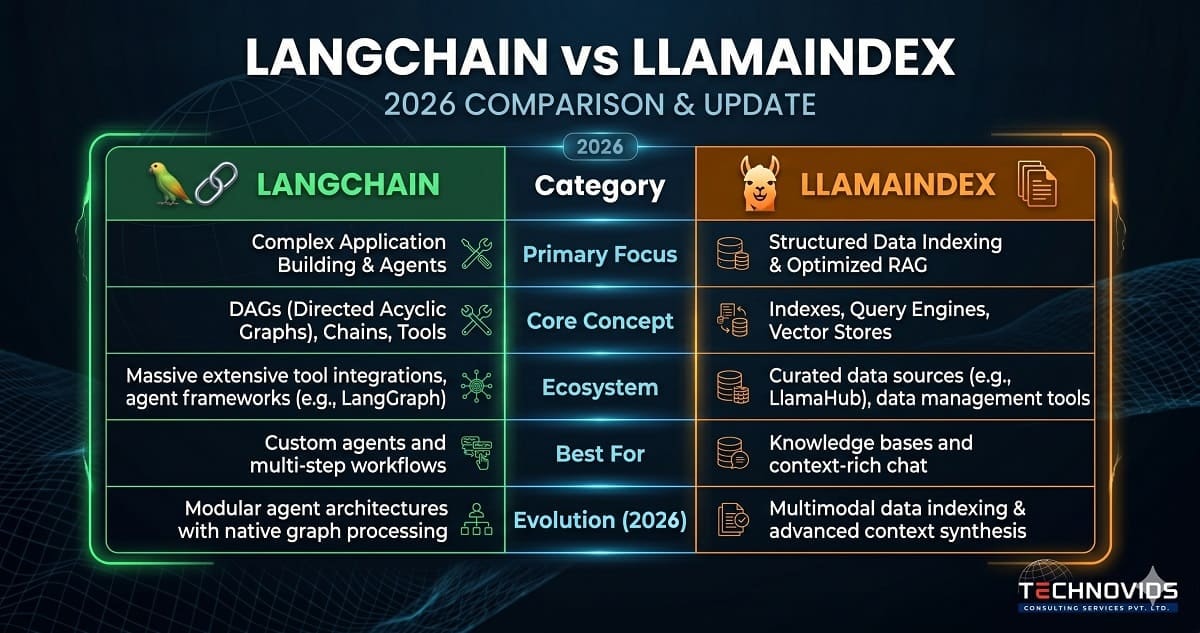
If you are learning to build LLM applications in Python, you will encounter LangChain and LlamaIndex within the first week. Both are open-source, both have excellent documentation, and both claim to solve the same problem. Choosing between them — or deciding whether to learn both — is one of the most common questions we get from developers attending our training programmes.
This is an honest comparison, not a marketing post for either framework, updated for 2026. Both frameworks have matured since this question first came up: LangChain and LangGraph reached version 1.0 in October 2025, and LlamaIndex has grown its Workflows feature for event-driven, multi-step pipelines alongside its data connectors. We teach both in our corporate programmes, and this comparison reflects what developers run into when they build with them.
What is LangChain?
LangChain is a framework for building applications powered by large language models. It provides composable building blocks — chains, agents, tools, memory, and retrievers — that let you connect LLMs to data sources, external APIs, and multi-step workflows without writing every integration from scratch.
LangChain's core strength is orchestration. You can build a pipeline that retrieves relevant documents, reformats them, passes them to an LLM with a specific prompt, parses the structured output, calls an API based on that output, and logs the result — all as a composable chain. What would take hundreds of lines of custom code becomes a few dozen with LangChain.
LangGraph extends LangChain for agentic use cases — where the AI needs to loop, branch, maintain state, and make decisions across many steps. LangGraph is one of the most widely used frameworks for building production-grade AI agents, and it is part of the same ecosystem as LangChain. Since version 1.0, LangChain’s own agents run on the LangGraph runtime. If you learn LangChain, you are one step from LangGraph.
LangChain also ships LangSmith — a tracing, debugging, and evaluation platform that is invaluable for understanding what your LLM application is actually doing. It is not free for heavy use, but for teams shipping production AI, it pays for itself in debugging hours.
What is LlamaIndex?
LlamaIndex is a framework specialised for connecting LLMs to data — ingesting, indexing, and querying large document collections. Where LangChain is a general-purpose LLM application framework, LlamaIndex is purpose-built for the data-to-LLM pipeline.
LlamaIndex's strength is the data layer. It has an extensive library of data connectors (for PDFs, Notion, Confluence, databases, APIs, and more), sophisticated indexing strategies (vector stores, summary indexes, keyword tables, knowledge graphs), and flexible query engines. If you need to ingest 50,000 documents across multiple formats and query them accurately, LlamaIndex's native tooling will get you there faster than LangChain.
LlamaIndex also has strong support for advanced RAG patterns: multi-document agents, recursive retrieval, sub-question decomposition, and structured data querying alongside unstructured documents. For complex data retrieval scenarios, it is simply better-designed than LangChain for the retrieval layer.
Core Differences: What Each One Is Actually For
The confusion between these frameworks comes from the fact that both can build RAG systems, both support agents, and both can be used end-to-end. But their strengths are different, and using the wrong one for the wrong job creates unnecessary friction.
LangChain is best for: Full-stack LLM application development — chains, agents, tool calling, memory, multi-step workflows, and production deployment. It is the right choice when your primary challenge is orchestrating what the AI does, not how it retrieves data.
LlamaIndex is best for: Data ingestion and intelligent retrieval — indexing large, complex document collections and querying them with high precision. It is the right choice when your primary challenge is getting the right information to the LLM, not what the LLM does with it afterwards.
The mental model that works for our students: LangChain is the application layer. LlamaIndex is the data layer. In a well-architected production system, they often play different roles in the same pipeline.
When to Use LangChain (and LangGraph)
Choose LangChain as your primary framework when:
- You are building a multi-step workflow that involves tools, APIs, or conditional logic — not just a retrieval-and-answer loop.
- You need agents. LangGraph (the LangChain agent framework) is a mature, production-ready option for stateful agents in 2026.
- You need tracing and debugging across complex pipelines. LangSmith integrates natively.
- Your team wants the largest community, the most Stack Overflow answers, and the most tutorial coverage. LangChain wins on all three.
- You are building general LLM applications beyond RAG — chatbots, summarisation pipelines, structured extraction workflows, AI-powered APIs.
When to Use LlamaIndex
Choose LlamaIndex as your primary framework when:
- You are building a knowledge base or document QA system over a large, complex, mixed-format document collection.
- You need advanced retrieval patterns: recursive retrieval, multi-document reasoning, sub-question decomposition, or hybrid structured/unstructured queries.
- Your documents come from many different sources (Confluence, Notion, SharePoint, databases) and you need a unified ingestion pipeline.
- RAG retrieval quality is your primary bottleneck — you need more control over chunking, indexing, and query strategies than LangChain's retriever abstraction provides out of the box.
Can You Use Both Together?
Yes — and many production systems do. A common pattern: LlamaIndex handles the document ingestion pipeline and the retrieval layer (taking advantage of its rich data connectors and indexing strategies), while LangChain orchestrates the application logic and agent behaviour on top of the retrieval results.
LlamaIndex has a LangChain integration that lets you use a LlamaIndex QueryEngine as a LangChain retriever tool. This gives you the best of both: LlamaIndex's retrieval precision and LangChain's orchestration power.
That said, for most teams starting out, learning two frameworks simultaneously creates unnecessary cognitive load. Pick one to start, build something real with it, and add the second when you hit a limitation that the first cannot address.
Our Recommendation for Indian Developer Teams
Start with LangChain. Add LlamaIndex when you need it.
This is what we teach in our Production AI Engineering corporate programme and it reflects what we see in training: developers who ship one working application with a single framework pick up the second one faster.
LangChain has the larger community, more learning resources, more production examples, and — through LangGraph — the best agentic AI story. Most enterprise AI projects in India are building RAG chatbots and knowledge assistants. LangChain handles these well out of the box.
The time to bring in LlamaIndex is when you hit retrieval quality ceilings that LangChain's retriever abstraction cannot address — which happens, but typically after you have already shipped something with LangChain and know specifically what is breaking.
Both frameworks are covered in depth in our training. See our LangChain training for Indian developer teams for more detail on what the hands-on programme covers.